The Sierpiński Triangle
A triangle made of three triangles, each made of three triangles, and so on without end. It is the simplest fractal to build and one of the most revealing.
The shape
Start with a solid equilateral triangle. Join the midpoints of its three sides and remove the small upside-down triangle in the middle, which leaves three half-size triangles. Now do the same to each of those, and again, and again, forever. What remains is the Sierpiński triangle, also called the Sierpiński gasket or sieve.
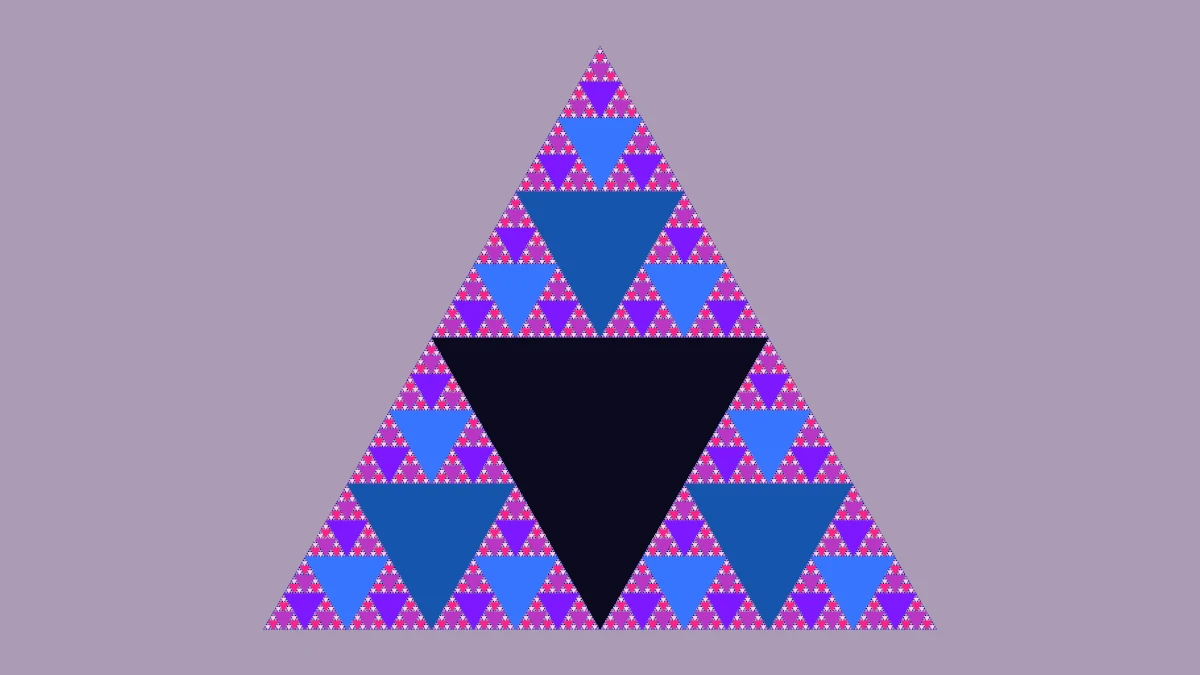
It is unlike the other fractals in this encyclopedia. Nothing "escapes", and no equation of the form is iterated. The shape is defined directly by a repeating geometric rule, which is why the explorer can draw it exactly, at any depth.
A short history
The Polish mathematician Wacław Sierpiński described the triangle in 1915 as an example of a curve in which every point is a branching point. The following year he described the square version, now known as the Sierpiński carpet. Benoit Mandelbrot later used both as classic examples of the self-similar shapes he called fractals.
Zero area, endless edge
Each cut leaves three triangles, each half as wide as before. After cuts there are triangles whose side is of the original, so the area left is of the start. That heads to zero, so the finished shape has no area at all. Yet the total length of its edges is multiplied by at every cut and grows without limit. It is something in between a line and a surface, and mathematicians measure that "in between" with a number, its dimension.
Three half-size copies rebuild the whole, so the shape is exactly self-similar. Halving the size takes 3 copies to rebuild the whole, which gives a Hausdorff dimension of
Plain text: D = ln 3 / ln 2 ≈ 1.585
That is greater than 1 (a line) and less than 2 (a filled area).
Four ways to build the same shape
Cutting
The method above: remove the middle triangle, repeat.
The chaos game
Mark three corners. Start anywhere, then repeatedly jump halfway toward a randomly chosen corner and plot the point you land on. After the first few jumps the dots trace out the Sierpiński triangle, so order emerges from pure chance. Michael Barnsley popularized this construction.
Pascal's triangle
Write out Pascal's triangle, where each number is the sum of the two above it, then color the odd numbers and leave the even ones blank. The pattern is the Sierpiński triangle. A related cellular automaton, Wolfram's Rule 90, draws it too.
Binary digits
This is the method the explorer uses. Draw the right-angled version in the unit square, with across and up. A point belongs to the triangle exactly when the binary digits of and are never both 1 in the same position. It is the Pascal's triangle rule in disguise, and it can be tested one digit at a time. The explorer then stretches the right-angled picture into an equilateral triangle with corners at , and .
Zooming forever
For escape-time fractals the explorer needs perturbation theory to go deep. The Sierpiński triangle is easier: the first few binary digits of a pixel are resolved exactly with big-integer arithmetic, and the remaining digits are checked in ordinary numbers. The picture is therefore exact at any depth, up to the same limit of about 10300 as the other fractals.
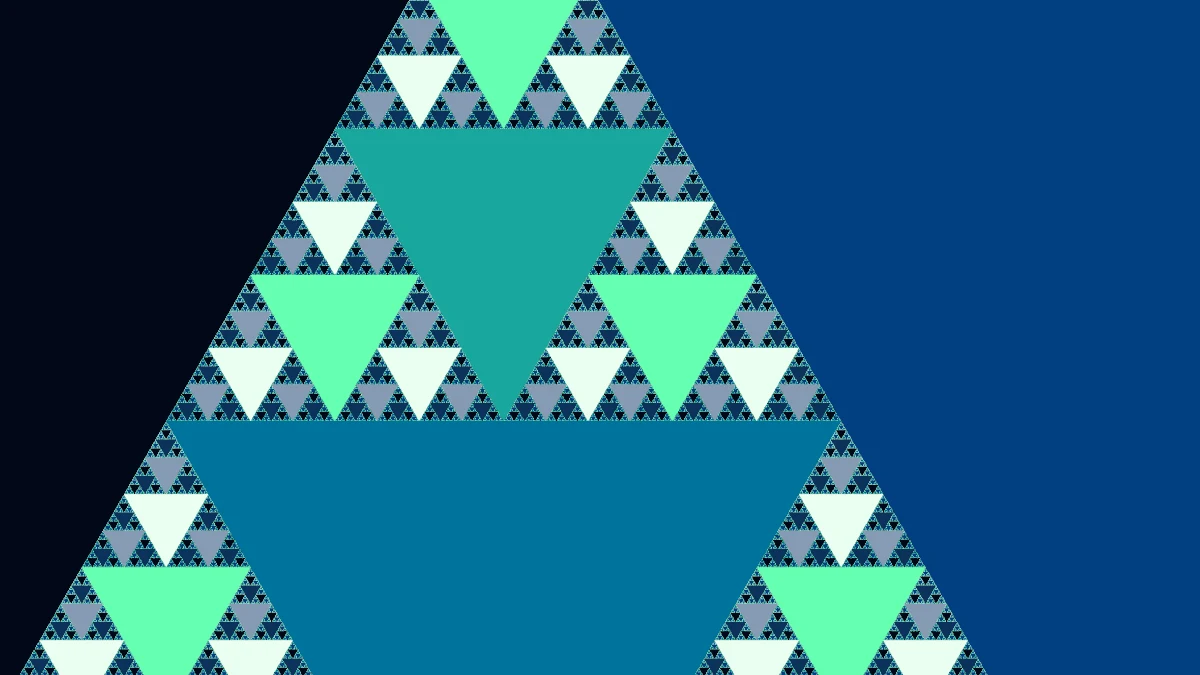
The tour's Infinite Sierpiński view is centered on the point , . In binary these are and , which never clash and which repeat every three digits. Zooming in by a factor of 8, three octaves, therefore brings you back to what looks like the same picture. It sits at a magnification of the order of 1054, and you can keep going.
In the explorer
Try this: choose Sierpiński in the fractal list, then scroll or pinch to zoom as far as you like. Press R to reset the view. There is no Julia set here, so J does nothing; the shape has no parameter to vary.
To see how the other fractals are drawn, read How the explorer works.