The Burning Ship
Take the absolute value of each part of the number before squaring, and the smooth Mandelbrot heart turns into a jagged, angular ship with masts and flames.
The rule
The Burning Ship uses the same recipe as the Mandelbrot set, with one change: before squaring, take the absolute value of the real part and of the imaginary part of . Negative parts are folded onto positive ones.
Plain text: z → (|Re z| + i|Im z|)² + c
Writing and , one step is just
Plain text: x' = x² − y² + a, y' = 2|x||y| + b
Compared with the Mandelbrot rule, only the imaginary update changes, from to . Points are colored exactly as before: by how quickly they escape.
A short history
The Burning Ship was first described in 1992 by Michael Michelitsch and Otto Rössler, the latter better known for the Rössler attractor in chaos theory. They called its Julia-like relatives "quasi-Julia sets". The name comes from the picture itself. Plotted with the imaginary axis pointing down, which is the usual convention and the one the explorer uses, the main body looks like a ship with tall masts, and the ragged structures around it like flames.
Why folding changes everything
An absolute value is a fold: it reflects half the plane onto the other half and leaves a crease. Every step creases the plane again, and the result is a landscape that is jagged and architectural rather than round and flowing. The Mandelbrot map is "analytic" (smooth in the complex sense), and that lets mathematicians use the powerful machinery of Fatou, Julia, Douady and Hubbard. The absolute value breaks analyticity, so that theory does not apply directly, and the Burning Ship is explored largely by experiment.
Unlike the Mandelbrot set, the Burning Ship is lopsided: the two folds treat the plane unevenly and there is no mirror symmetry to lean on. Along the real axis itself the two sets still agree. For real numbers the folds change nothing before squaring, so both sets cross the real axis between and .
What to look for
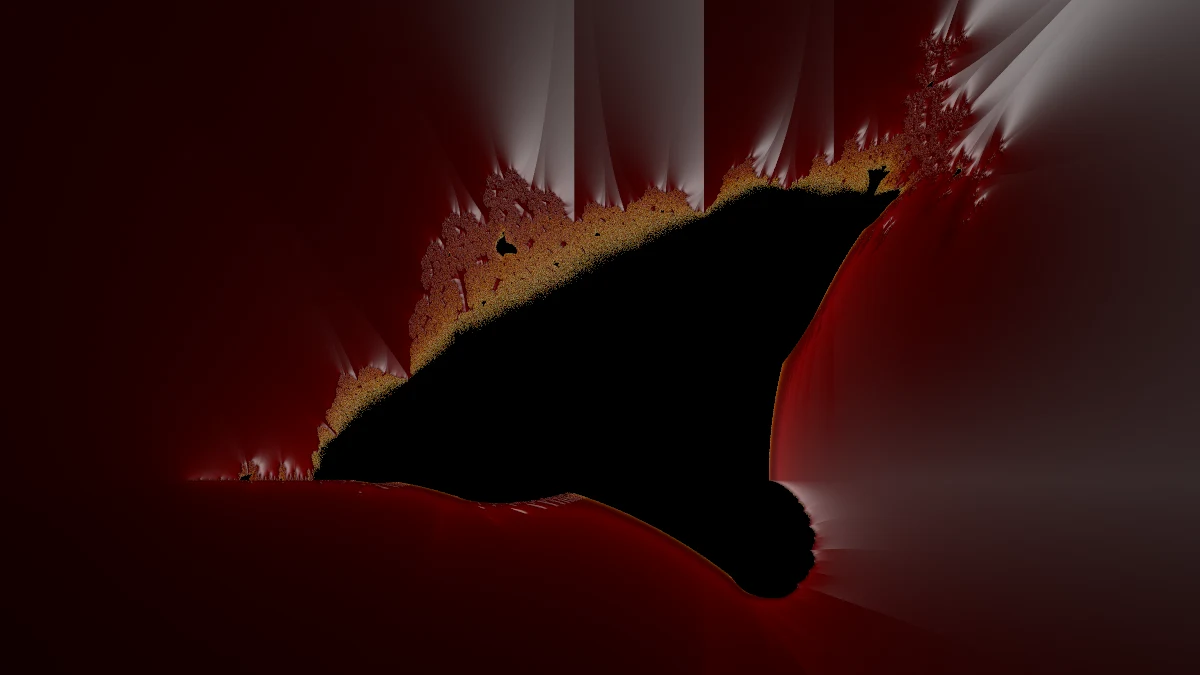
At the home view the black body has a flat lower edge, which is the real axis, and a ragged upper edge of spiky, ship-like growths: the masts and flames. Smaller copies of the ship sit along the real axis toward the left.
The armada
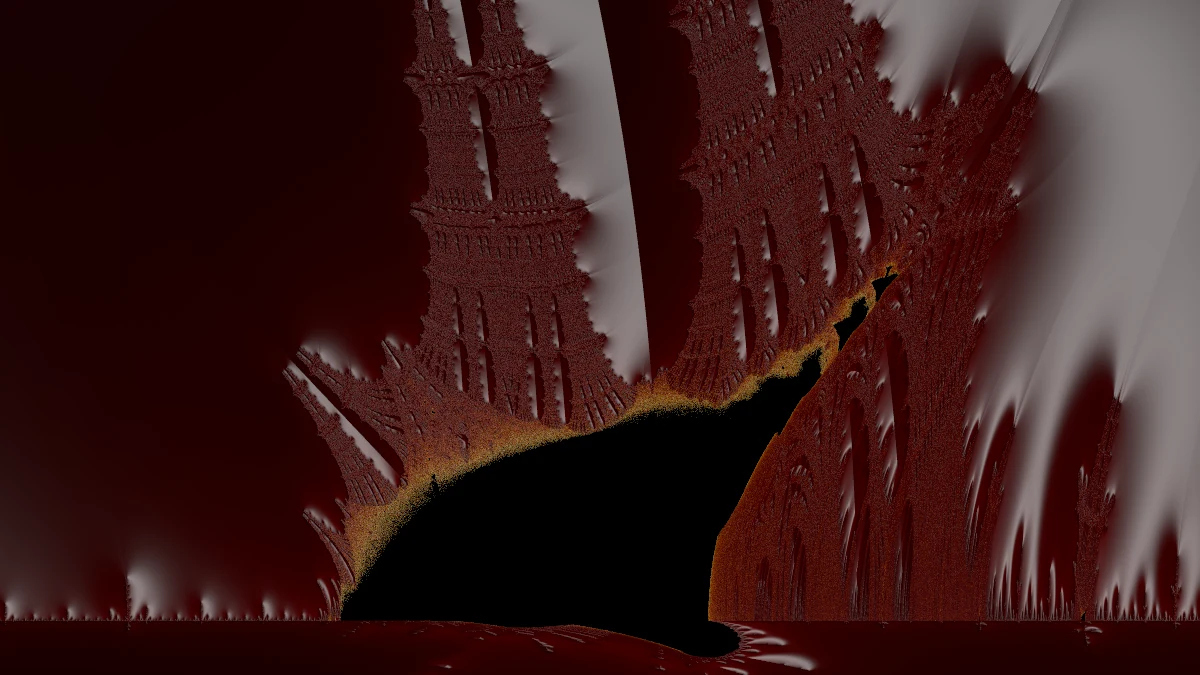
Zoom into the left end of the main ship, near , and the masts resolve into tall, latticed towers of fine structure, with a smaller ship hull at their base. The tour calls this region the Burning Ship armada.
Variations to try
- Julia versions. Fix and vary the starting point to get a "quasi-Julia" set: Burning Ship Julia, c = -1.62 - 0.02i.
- Other powers. The power control in the Shape section works here too. Cubic ship.
- Shading. Relief lighting makes the creases look like cliffs; try filament shading for the thin outlines.
In the explorer
Try this: hover over any point and press J. The Burning Ship is a Mandelbrot-type fractal, so it has its own Julia sets, and the live preview follows your pointer. Press R to reset the view.
Next, a close cousin that folds in a different way: the Tricorn.